
The modern Homo sapiens cannot be amazed by anything from yesterday. He saw everything and knows everything. Media fiercely struggle every day for every millimeter of the spiritual response and withdraw from the occupied territories only after having trice verified that they had depleted them all the way. The ingenuity of media art reaches fantastic proportions. Artists are compelled to grow the longest legs for their works in order to carefully thread the scorched earth. With every passing day, they construct most complex neural networks for an abstract presentation of their thought. In retrospect, one can notice that the naiveté and simplicity of the past came to its contemporaries only through hard work, advanced thinking and remarkable ingenuity. Nowadays, it is still the same. The cutting edge of avant-garde, the frontline where brainstorms would never cease, lies on some other territories. Our program has two poles – at the one, there are pioneers of electronic sound, trailblazers in the use of computers and algorithms in a new and unusual role, fiercely connecting computers with analog synthesizers, and at the other, there are contemporary sound designers who deliberately abandoned the result of the modern computerization of studios and instruments; they only use the simplest and, at times, even primitive equipment. It should be noted that, as often as not, these are computer programmers, which emphasizes the irony of this round of evolution. The space between these two poles is, in fact, the content of our program "Unprecedented Worlds" that are created by the artists who look at one another through time.
Sergey Komarov,
CYLAND, curator of sound art archive
CYLAND AUDIO ARCHIVE CAA-2012-0 CYBERFEST 2012 SOUND ART COMPILATION
- Hans Tammen — Choking Disklavier #9
- Kurvenschreiber — ta_rec_12 (2011)
- dropouT — except from Sleeping Pills (2010)
- Don Slepian — except from Evolution (1975)
- Mark Hannesson — exc. from The Safety of Blankets
- Quiet Zone — except from Headspace (2007)
- Laurie Spiegel — Passage (1991)
- Nick Edwards — Tunnel Vision pt.2 (2012)
- ::vtol:: — Heliotic (2012)
- Alex Pleninger — except from Vox Populi (2012)

Laurie Spiegel (USA)
Unseen Worlds
Laurie Spiegel is an American composer seen by many as a pioneer of the New York new-music scene. Spiegel uses technology as a means of expressing her musical and artistic ideas, such as the automation of sonic processes and special composition software development.
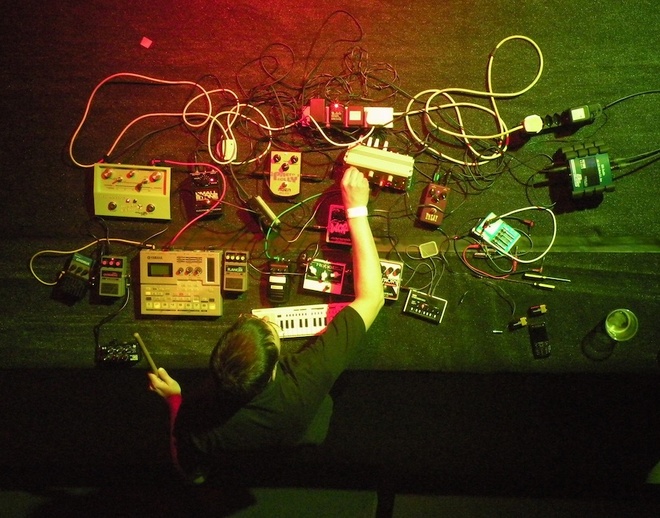
Nick Edwards (UK)
Tunnel Visions
This piece is performed using improvised analog electronics and recorded to multitrack cassette tape. A sonic journey through fictional space, inspired by childhood memories and science fiction/horror soundtracks. Moving through an oppressive vortex, in search of light at the end of the tunnel, but never reaching its destination.
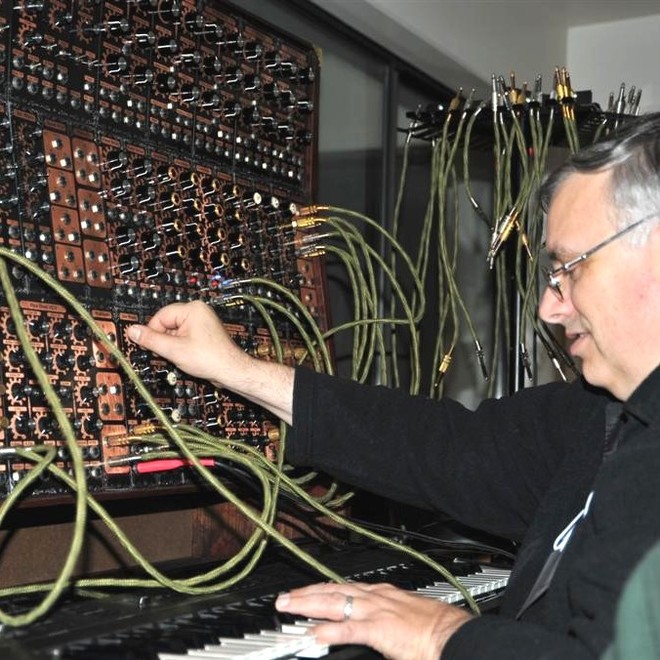
Don Slepian (USA)
EMRI
Don Slepian combines skills in music and electronics in a career of performing original improvised electronic music in Renaissance, Baroque, and Romantic styles as a Classitronic Keyboardist. He designs and builds computer instruments, runs an acoustic music concert series, presents interactive video webcasts, and mentors electronic keyboardists looking to expand their techniques.
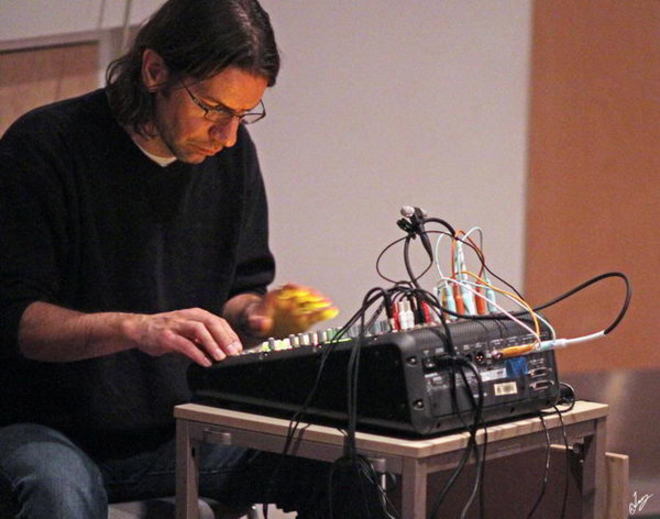
Mark Hannesson (Canada)
The Safety of Blankets
The Safety of Blankets is a pseudo-imaginary soundscape. Recordings were made of my children playing and singing in a blanket fort. I began to consider the idea of facing the many monsters of the world from the security of hiding under blankets and how not seeing a threat seems to make it go away. Time is stretched and distorted to mimic how a child experiences it. Beyond that very little processing is carried out on the recordings.
Alex Pleninger (Russia)
Vox Populi
Alex Pleninger is a composer and sound artist, creating electronic music since the late 80's. In the early 90's he participated in the creation of sound bases of several famous synthesisers. Pleninger writes music for film and theatre, as well as consults many sound studios across the country. In recent years, he was actively engaged in combining academic electronic sound with so-called chip-tune.
Quietzone.in (Russia)
Headspace
This living and ever-changing mix of abstract sounds created by Quiet Zone blends in real-time to produce an eternal and regenerating non-repetitive audio piece. This audio was originally presented in 2007 in quadraphonic sound at the Copy! festival in Zurich, Switzerland.
Quiet Zone is a boutique net-label, launched to explore the subtle area between sound and silence, between contemplation and cogitation, between merely audible background noises and heartfelt melodies, between directly perceived reality ‘as it is’ and the psychically induced, hazy representation of it which we assume to be ‘real’ inside our heads. Ambient music, field recordings and meditative sound sets. All audio is available for free downloading.

top-40 (Russia)
top-40 Compilation
top-40.org is a free distribution net-label based in Moscow, Russia. The label releases innovative and interesting music from artists around the world, in a variety of genres: experimental electronica, microwave/glitch, techno, ambient, field recordings, drones, contemporary jazz, modern classical and much more. All content is available for free downloading.

Motor (Russia)
Abstrakt Machine
Abstrakt Machine is an ambient sound-generating apparatus, powered by granular synthesis technology. Myriads of audio-grains both artificial and natural are all mixed up, creating an abstract and dense cloud of sound that covers you like a warm blanket. Produced, recorded and composed by Motor (Vadim Ugryumov). Originally released at top-40 net-label .

dropouT (Russia)
Cycle Of Audio Works 2009-2011
dropouT is one of the latest projects of Vadim Ugryumov (also known as Motor), founder of the top-40.org and Quiet Zone net-labels. The ongoing cycle includes five albums to date, each an audio recollection of certain events and periods in the artist’s life. Every sound represents an exact moment, invoking memories of particular events, both factually and emotionally accurate. Mixed together, they provide a unique, insightful experience, a whole life flashed before your eyes – in the form of sound.

Hans Tammen (USA)
The Choking Disklavier
Imagine the Disklavier in the center of the stage, the composer/ performer somewhat distant to the side. Several microphones are put into position not over the strings, but this time at the hammers and keys. Remotely controlled by the composer/performer, the piano produces constantly rumbled and crackled noises, often very rhythmically, occasionally ringing strings are added on top, or stopping for a few seconds on a chord.
On a musical level this piece explores the sonic capabilities of the Disklavier machines. These instruments have hidden sonic qualities, and I try to explore these the same way I do with guitars for 20 years. The music will develop slowly, as there is a lot to discover for the listener.
On a technical level the Disklavier is fed too much information at the lowest possible volume. At this point the hammers do not have enough power to bang the strings anymore, and ideally they only vibrate to produce a low rumbling sound. Occasionally the MIDI brain even stops for a few seconds on a chord due to the data overload, hence the title The Choking Disklavier.
Hans Tammen
Kurvenschreiber (Russia)
32 Is For Space
Kurvenschreiber is a synth trio and occasionally a quartet. Sound concept can be described in disyllabic German title — something, that draws a curve. Sound waves generation from such curves happens, when electrons beat in analog circuits. This process needs to be recorded on the film, and its magnetic properties are not just a fashion tribute, but a necessity for those, interested in a delicate processes, natural frequencies and their resonances. aaquo;Kurventronika» is always a group improvisation, eliminating repetition. «32» is the ASCII-code for the space key. Finding inspiration in the aesthetics of early computing and cyberpunk, Kurvenschreiber fixate their research in musical matters.
::vtol:: (Russia)
Heliotic
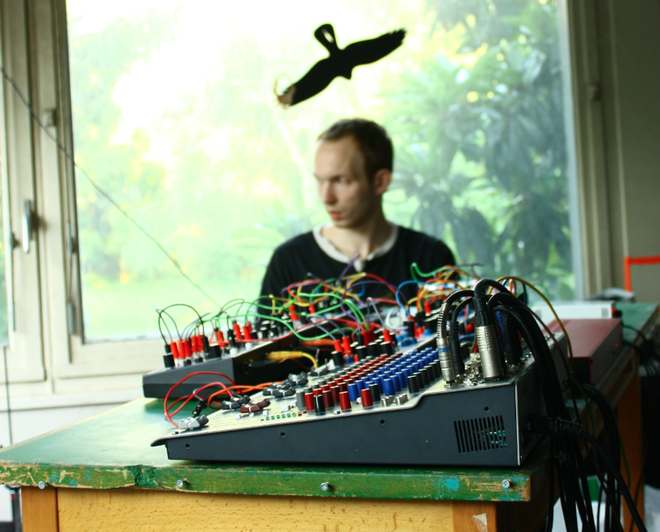
::vtol:: is a project of an artist, musician and the strange-sounding machines creator Moscow based Dmitry Morozov. Circuit bending has become his main engineering and creative approach to composition — the creative customization of the circuits within electronic devices such as low voltage, battery-powered guitar effects, children's toys and small digital synthesizers to create new musical or visual instruments and sound generators.

Paul Amlehn (New Zealand)
Photo 'Woman Thinking # 2' by David Lynch. Copyright David Lynch
- Blood of Union
- Le Verger
- The Abyssal Self Projecting Through Non-Existence the Procreatrix I
- Ursula Naguschewski
- Song (For Ariel)
- The Snow of Your Name
- Lucifer I
- Through Your Mouth, I Sing
- The Garden of Earthly Delights VI: The Spurt of Blood
The process for creating these works was an aleatory one. I sent a capella versions of my vocal performances to musicians in various parts of the world. Each musician heard the same reference point, the vocal, but none of the musicians heard what any of the other musicians were doing. In this way, the portal of chance was opened and the magic was able to come through. Then the musical contributions were sent to me to write and record new texts and vocals for, and to edit and arrange into the final works.
Some of the pieces also used a process called V-A Synthesis (Visual-Aural Synthesis), whereby an image, (in this case paintings by Gerhard Richter — who is also supplying the cover art for several of the albums) is inputted into a computer program. The program interprets the image as a graphic score and alters the music according to that score (height mapped to pitch, color mapped to volume, etc.).
For CYBERFEST I chose works which I felt resonated with the thematic and conceptual material of At Heaven’s Door, in particular, the aforementioned doorway into a realm of meta-reality, and also the Stalker reference mentioned in the curator’s brief.
Paul Amlehn
Musicians who contributed to the works are: Paul Amlehn, Ariel Lorca, Leo Abrahams (Brian Eno), David Van Tieghem (Laurie Anderson), Oren Ambarchi (Sun O)))), Andrew Sterman (Philip Glass Ensemble), Jamie Saft (John Zorn), Hopek Quirin (Six or Seven), Terry Edwards (PJ Harvey), Jem Finer (The Pogues), Michael Blair (Tom Waits), Ulf Ivarsson (Michael Blair), Philippe Nahon (Gaspar Noe), Daniele Pagliero (Nurse With Wound), Dieter Moebius (Cluster), Robin Storey (Zoviet France), AD Chivers (Peter Gabriel), Adi Newton (T.A.G.C), BJ Nilsen (Hazard), Mark Spybey (Dead Voices on Air), Bela Emerson (The Damned), Mick Rossi (Philip Glass Ensemble), Gerhard Richter, MS Waldron (Nurse With Wound), Eleonor Sandresky (Philip Glass Ensemble), David Crowell (Philip Glass Ensemble), Ju Suk Reet Meate (Nurse With Wound), Robert Fripp (King Crimson), Michael Begg (Human Greed), Jeffrey Zeigler (Kronos Quartet).